
Every successful project begins with one crucial step: validating the idea before committing valuable time, capital, and resources. That’s where a feasibility study report becomes essential. More than just a document, it acts as a strategic decision-making tool that transforms assumptions into data-driven insights.
In this guide, we’ll discuss what a feasibility study report is, why it matters, its core elements, different types, and real-world examples to help you understand how it works in practice.
What Is a Feasibility Study Report?
A feasibility study report is a detailed evaluation prepared before launching a project to determine whether the idea is realistic, viable, and worth investing in. Instead of moving forward on assumptions, this report analyzes key factors, including projected costs, expected returns, market conditions, technical requirements, and potential risks.
Why Is a Feasibility Study Report Important?
A feasibility study report helps organizations:
- Spot possible obstacles before committing major time and money.
- Assess whether the project makes financial and operational sense.
- Support strategic decisions with reliable data and analysis.
- Minimize risk while improving the chances of overall project success.
To address project delays uncovered during feasibility evaluation, enroll in our delay analysis and claim management course today to learn practical skills.
Feasibility Study Report Format
Here is a feasibility study report format to help you understand how the document is structured and organized:
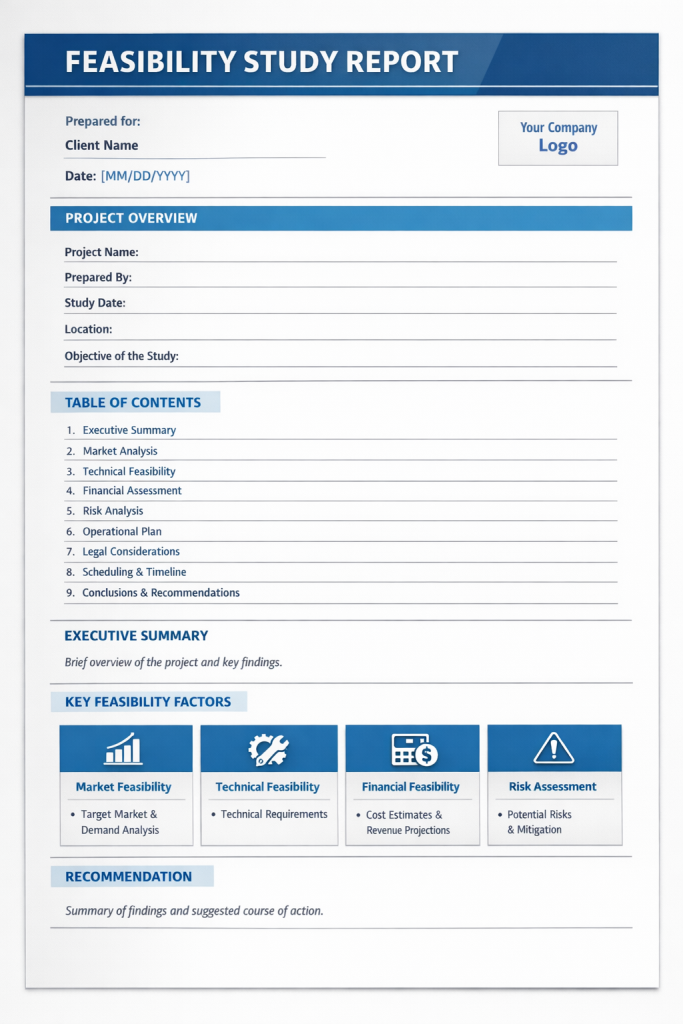
Want to Know Why Feasibility Report is Essential for Every Project!
Have a look at our detailed guide on what is a feasibility report and why every project needs it:
9 Core Elements of a Feasibility Study Report
Below are the essential components that make a feasibility study report:
1. Executive Overview
This section delivers a clear snapshot of the entire study. It outlines the project concept, objectives, overall investment required, major risks, and the final recommendation. Decision-makers should understand the opportunity and its potential impact within a few minutes of reading this section.
2. Project Background and Scope
Here, the report explains what the project is about, why it is being proposed, and what it aims to achieve. It defines boundaries, deliverables, timeline expectations, and the problem the project intends to solve. This section ensures that stakeholders clearly understand the initiative’s purpose and strategic relevance.
3. Industry and Market Evaluation
This part analyzes external factors that influence success. It covers:
- Target customer segments
- Market size and growth potential
- Current industry trends
- Competitive landscape
- Customer behavior and purchasing patterns
4. Technical Assessment
This section examines whether the necessary technology, infrastructure, equipment, and expertise are available. It evaluates:
- Required systems or machinery
- Production capacity
- Technology limitations
- Integration challenges
- Maintenance and scalability considerations
Our EPC planning and plant shutdown management courses provide hands-on techniques to assess technical feasibility in complex engineering projects.
5. Financial Evaluation
The financial section provides a detailed breakdown of projected costs and expected returns, including:
- Capital expenditure (CAPEX)
- Operating expenses (OPEX)
- Revenue projections
- Cash flow forecasts
- Break-even analysis
- Return on investment (ROI)
6. Operational Planning
Operational feasibility focuses on execution. It assesses whether the organization has:
- Skilled workforce
- Effective management structure
- Internal processes
- Supply chain capabilities
7. Legal and Compliance Review
Every project must align with regulatory requirements. This section evaluates:
- Licensing and permits
- Industry standards
- Environmental regulations
- Contractual obligations
- Data protection and safety laws
8. Risk Identification and Mitigation Strategy
No project is risk-free. This section identifies potential threats such as:
- Financial uncertainties
- Market volatility
- Technological failures
- Regulatory changes
- Operational disruptions
It also proposes mitigation plans to reduce the likelihood or impact of these risks.
9. Final Recommendation and Action Plan
The report concludes with a clear decision: proceed, revise, delay, or cancel. It also suggests phased implementation, cost adjustments, or strategic partnerships to improve feasibility.
Types of Feasibility Study In Project Management
Feasibility assessments can focus on different dimensions depending on project complexity. The most common types include:
1. Technical Feasibility: Determines whether the required systems, tools, and expertise exist to deliver the project successfully.
2. Financial Feasibility: Evaluates investment requirements, projected profitability, funding sources, and financial risk exposure.
3. Market Feasibility: Analyzes customer demand, pricing strategy, competitor positioning, and overall market opportunity.
4. Operational Feasibility: Examines internal capabilities, staffing needs, workflow processes, and long-term sustainability.
5. Legal and Regulatory Feasibility: Assesses compliance requirements, industry-specific regulations, and legal constraints.
Feasibility Report Examples
To better understand how feasibility studies apply in real-world situations, consider the following examples from different industries:
Example 1: Feasibility Study for an E-Commerce Clothing Brand
Executive Overview
The proposal evaluates launching an online fashion brand targeting eco-conscious consumers.
- Estimated startup investment: $300,000
- Expected break-even period: 14–16 months
Market Evaluation
- Target audience: Millennials and Gen Z shoppers
- Market trend: Increasing demand for sustainable fashion
- Competitive landscape: Moderate competition with strong differentiation potential
Financial Highlights
- Projected annual revenue: $950,000 (Year 1)
- Gross margin: 40%
- Online marketing budget: 20% of revenue
Example 2: Feasibility Study for a Telemedicine Platform
Executive Overview
The project explores launching a digital healthcare platform connecting patients with licensed doctors remotely.
- Estimated development cost: $450,000
- Launch timeline: 10 months
Technical Assessment
- Cloud-based infrastructure required
- Secure video consultation system
- Compliance with healthcare data protection standards
Financial Projection
- Revenue model: Pay-per-consultation and monthly subscription
- Estimated 25,000 active users within the first year
- Expected ROI: 22% within three years
Conclusion
A feasibility study report is a strategic blueprint that can make or break a project before it even begins. By carefully assessing financial viability, technical capabilities, market potential, operational readiness, and associated risks, it provides a clear picture of whether an idea is practical and worth pursuing.
In this guide, we discussed what a feasibility study report is, why it plays an important role, and how it is structured. We explored its nine core elements, different types of feasibility studies, and practical examples from industries.
By understanding these concepts, you can approach new projects with greater confidence and clarity. This knowledge helps reduce uncertainty, improve strategic decision-making, and minimize costly mistakes.